The Ultimate Guide to Typhoons, Hurricanes, and Cyclones: Differences in Origins and Characteristics
Every summer and fall, there is a weather phenomenon that inevitably makes the news: tropical cyclones, accompanied by tremendous wind and rain. Besides the familiar 'typhoon', we often hear terms like 'hurricane' and 'cyclone' in international news. In this article, we will clearly compare the differences between typhoons, hurricanes, and cyclones, and explore the characteristics of each weather phenomenon along with detailed preparation methods.
What is a Tropical Cyclone? (Common Traits)
To understand the differences between typhoons, hurricanes, and cyclones, you must first know that they are all the exact same weather phenomenon: **Tropical Cyclones**. A tropical cyclone refers to a powerful low-pressure system that forms and develops over tropical or subtropical oceans.
Conditions for Formation
This massive natural phenomenon requires very specific conditions to occur. It needs an abundant supply of water vapor from warm oceans with a surface temperature of 26.5°C (79.7°F) or higher, along with strong updrafts. The latent heat released as water vapor condenses becomes the core energy that fuels the storm.
Source of Destructive Power
As you get closer to the center of a tropical cyclone, the atmospheric pressure drops, and strong winds blow inwards in a spiral. Because they bring not only wind but also massive amounts of rain, they cause severe natural disasters such as coastal flooding, landslides, and infrastructure damage. In short, despite their different names, all three are massive storms with fundamentally the same destructive power.
The Crucial Difference: Regions of Origin
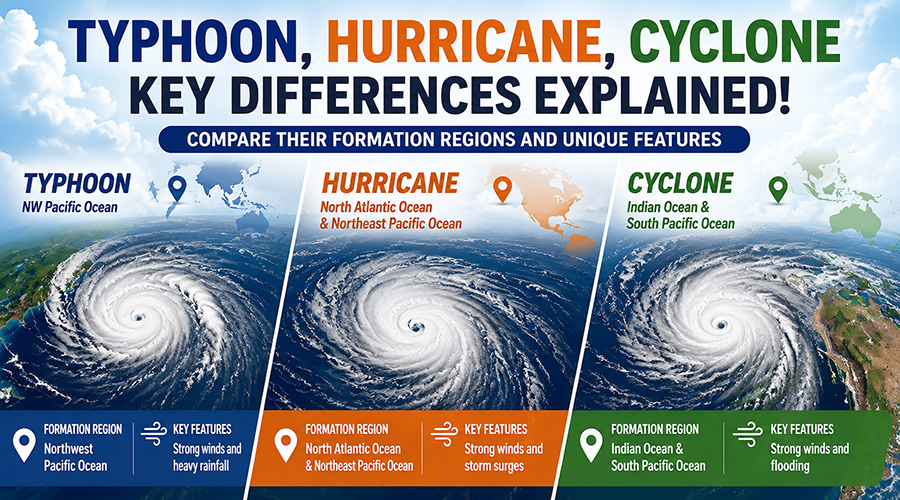
The sole and most important reason they are called different names is their **'region of origin.'** The World Meteorological Organization (WMO) has divided the world's oceans into basins, assigning unique names to tropical cyclones that form in each region.
Typhoon
A typhoon is a tropical cyclone that forms in the western North Pacific. South Korea, Japan, China, Taiwan, and the Philippines fall under the main influence of typhoons. They are most active between July and October, causing massive impacts on East Asia.
Hurricane
A hurricane is a tropical cyclone that forms in the North Atlantic, the Caribbean Sea, the Gulf of Mexico, and the eastern North Pacific. They primarily cause significant damage to the United States, Mexico, and Central American countries. The name 'hurricane' originates from 'Huracan,' the god of evil of the indigenous people of the Caribbean.
Cyclone
A cyclone refers to a tropical cyclone that forms in the Indian Ocean and the South Pacific. India, Bangladesh, Myanmar, Madagascar, and Australia are in its path. A unique characteristic is that cyclones forming in the Southern Hemisphere (like near Australia) spin clockwise, opposite to those in the Northern Hemisphere, due to the Earth's rotation.
Different Names, Same Power? (Comparison of Criteria and Characteristics)
Although the names differ by region, they all share the common trait of bringing strong wind and rain. Each region's meteorological agency classifies tropical cyclones based on wind speed, and there are slight differences in rotation direction and observation criteria depending on the region. Let's compare these intuitively through a table.
| Category | Typhoon | Hurricane | Cyclone |
|---|---|---|---|
| Region of Origin | Western North Pacific | North Atlantic, Eastern North Pacific | Indian Ocean, South Pacific |
| Major Affected Countries | South Korea, Japan, China, Philippines | USA, Mexico, Cuba | India, Australia, Myanmar |
| Classification Criteria (Wind Speed) | Maximum wind speed of 17 m/s or higher | Maximum wind speed of 33 m/s or higher | Maximum wind speed of 17 m/s or higher (varies by region) |
| Rotation Direction | Counterclockwise | Counterclockwise | Northern Hemisphere: Counterclockwise / Southern Hemisphere: Clockwise |
| Active Season | Mainly July ~ October | Mainly June ~ November | Mainly April~May, October~November (Indian Ocean) |
As shown in the table above, countries like South Korea and Japan classify a storm as a typhoon when wind speeds reach 17 m/s or higher. However, the US only uses the term 'hurricane' when wind speeds reach 33 m/s (approx. 119 km/h) or higher. If the power is below that, it is called a 'Tropical Storm,' etc.
How Are Tropical Cyclones Named?
We often hear news reports like, "The 11th typhoon, Hinnamnor, is moving north." The reason tropical cyclones are given unique names is to prevent confusion and quickly relay information when multiple storms lasting for several days occur simultaneously. The naming conventions also vary by region.
| Name | Naming Organization and Method | Notes |
|---|---|---|
| Typhoon | ESCAP/WMO Typhoon Committee (14 member countries submit 10 names each) | 140 names are used sequentially; includes many native words for insects/plants |
| Hurricane | WMO Regional Association | Alternates male and female names alphabetically (6 lists in rotation) |
| Cyclone | Regional authorities like the India Meteorological Department | Uses names submitted by countries bordering the Indian Ocean |
Notably, the names of typhoons or hurricanes that have caused massive casualties or immense economic damage are permanently retired and replaced with new ones at the request of the affected country. For example, in South Korea, names like 'Rusa' and 'Maemi,' which caused tremendous damage in the past, were permanently retired at the request of the Typhoon Committee.
The Impact of Climate Change on Tropical Cyclones and How to Prepare
Recently, due to global warming, the nature of tropical cyclones is changing. As sea surface temperatures rise, phenomena of 'rapid intensification,' where typhoons and hurricanes gain more destructive power than in the past, are frequently observed.
Increasing Threats from Climate Change
Because warmer air can hold more water vapor, the amount of torrential rain is increasing exponentially. Furthermore, as the movement speed of storms slows down, they tend to linger over specific areas for longer periods, dumping intense rainfall and causing damage to snowball.
Preparation Methods to Minimize Damage
While natural disasters cannot be prevented, thorough preparation can reduce the damage. When a typhoon or hurricane warning is issued, the following guidelines must be strictly observed.
- Identify flood risks in your residential area and locate shelters in advance
- Secure and tape window frames to prepare for glass breakage (securing the frame is more important than a simple X shape)
- Prepare a survival backpack with emergency food, bottled water, a lantern, and a first-aid kit
- Move items outside that could be blown away, such as bicycles or potted plants, indoors
- Absolutely avoid approaching hazardous areas like riverbanks, coastlines, and breakwaters
Frequently Asked Questions (FAQ)
Which is the most powerful among typhoons, hurricanes, and cyclones?
Since they are all the exact same tropical cyclone phenomenon, there is no difference in power based on the name. The power is determined by environmental factors such as sea surface temperature and atmospheric conditions at the time of formation.
What is the difference between a cyclone and a tornado?
A cyclone is a massive tropical low-pressure system spanning hundreds of kilometers that forms over the ocean and lasts for days. In contrast, a tornado is a narrow, violent vortex that primarily forms over land and dissipates within minutes to hours.
Why don't tropical cyclones form near the equator?
For a tropical cyclone to develop and swirl, the Coriolis force (an effect of the Earth's rotation) is required. Near the equator, the Coriolis force is almost zero, preventing the formation of a vortex, so they mainly form at latitudes of 5 degrees or higher.
Can a hurricane hit South Korea?
Since the names differ by region of origin, it is practically impossible for a hurricane formed in the North Atlantic or Eastern North Pacific to cross over to South Korea in the Western North Pacific. Any tropical cyclone affecting South Korea is called a typhoon.
Are the names of tropical cyclones used permanently?
No. The names of typhoons or hurricanes that cause massive casualties or property damage are permanently retired and replaced with new names at the request of the affected country. 'Maemi' and 'Rusa', which caused severe damage to South Korea, are examples of this.
Final Thoughts
In conclusion, the **differences between typhoons, hurricanes, and cyclones** are not inherent meteorological differences, but rather geographical naming distinctions indicating **'which ocean they formed in.'** They are simply called typhoons in the western North Pacific, hurricanes near the Americas, and cyclones in the Indian Ocean and South Pacific; all are massive tropical cyclones that use the warm ocean as their energy source. Because these massive storms are becoming increasingly powerful due to climate change, it is more important than ever to stay informed with accurate weather information and practice thorough safety management in preparation for upcoming disasters.
Recommended Articles
-
 Gyeongbokgung Saenggwabang 2026: Korea’s Royal Dessert Experience & Booking Guide
A complete guide to the 2026 Gyeongbokgung Saenggwabang event in the second half of the year. Find out everything you need to know about the dates, ticket lottery system, royal dessert set menus (Sejong and Munjong), prices, and special live music performances. Get ready to experience traditional Korean royal court refreshments.
-
 Causes of Car AC Smells and How to Get Rid of Them
If your car air conditioner smells like a damp rag or has a musty odor, it could be more than just an unpleasant nuisance—it may be a sign that mold and bacteria are breeding inside. In this article, we will explore the causes of car AC odors, effective removal methods, and how to prevent them.
-
 Top 5 Best Foods to Eat in the Morning! Healthy Breakfast Ideas for an Empty Stomach
On busy mornings, many of us skip meals due to a lack of time or just grab whatever food is in sight before heading out. However, one of the most critical factors determining your daily condition is your 'breakfast.' In particular, the right morning foods protect the stomach lining—which becomes sensitive after being empty all night—and provide enough energy to the brain, helping you maintain high concentration and vitality throughout the morning. Conversely, the wrong menu choice can cause stomach cramps, heartburn, and fatigue. In this article, we will take a deep dive into 5 highly nutritious breakfast foods that are easy on the stomach, foods you should avoid, and quick meal plans tailored for busy modern people and children.
-
 The Ultimate Guide to January Zodiac Signs and Birthstones: Capricorn, Aquarius, Garnet, and Winter Stargazing
January, the start of a new year, is a special month filled with hope and resolutions. Those born in January fall under the fascinating zodiac signs of Capricorn or Aquarius, depending on their exact birth date. They are also blessed with the energy of the January birthstone, garnet, which symbolizes truth and friendship. Furthermore, the January night sky is the perfect time for winter stargazing, featuring the brightest and clearest stars of the year. In this guide, we will explore the traits of January zodiac signs, the symbolism and types of the garnet birthstone, and tips for observing the winter night sky.
-
 The Ultimate Guide to April Zodiac Signs: Horoscopes, Traits, and Spring Stargazing
From zodiac personality traits for April birthdays to tips on stargazing spring constellations, explore everything you need to know about the stars of April.
-
 February Zodiac Signs: Aquarius and Pisces Traits & Compatibility
We offer a complete breakdown of the February zodiac signs, Aquarius and Pisces, covering their unique traits, strengths, weaknesses, and romantic compatibility for those born in February.
-
 2026 Gyeongbokgung Starlight Tour in Seoul, South Korea: Booking Guide, Dates, Tickets & Dosirak Royal Meal
Enjoy a peaceful night at one of Korea's most famous royal palaces! Here is your complete guide to the Gyeongbokgung Starlight Tour, including booking schedules, the Doseuk Surasang traditional royal dinner, the guided tour course, and tips for securing your tickets.
-
 The Ultimate Guide to October Zodiac Signs & Birthstones! Libra, Scorpio Traits & Opal Meaning
October, with its refreshing autumn breeze, is the perfect month for observing beautiful constellations in the night sky. Those celebrating their birthdays in October are graced with unique October zodiac signs and the colorful brilliance of October birthstones. In this article, we dive into the characteristics of Libra and Scorpio based on birth dates, explore the mystical meanings behind October's birthstones—Opal and Tourmaline—and provide a detailed stargazing guide for the October night sky.